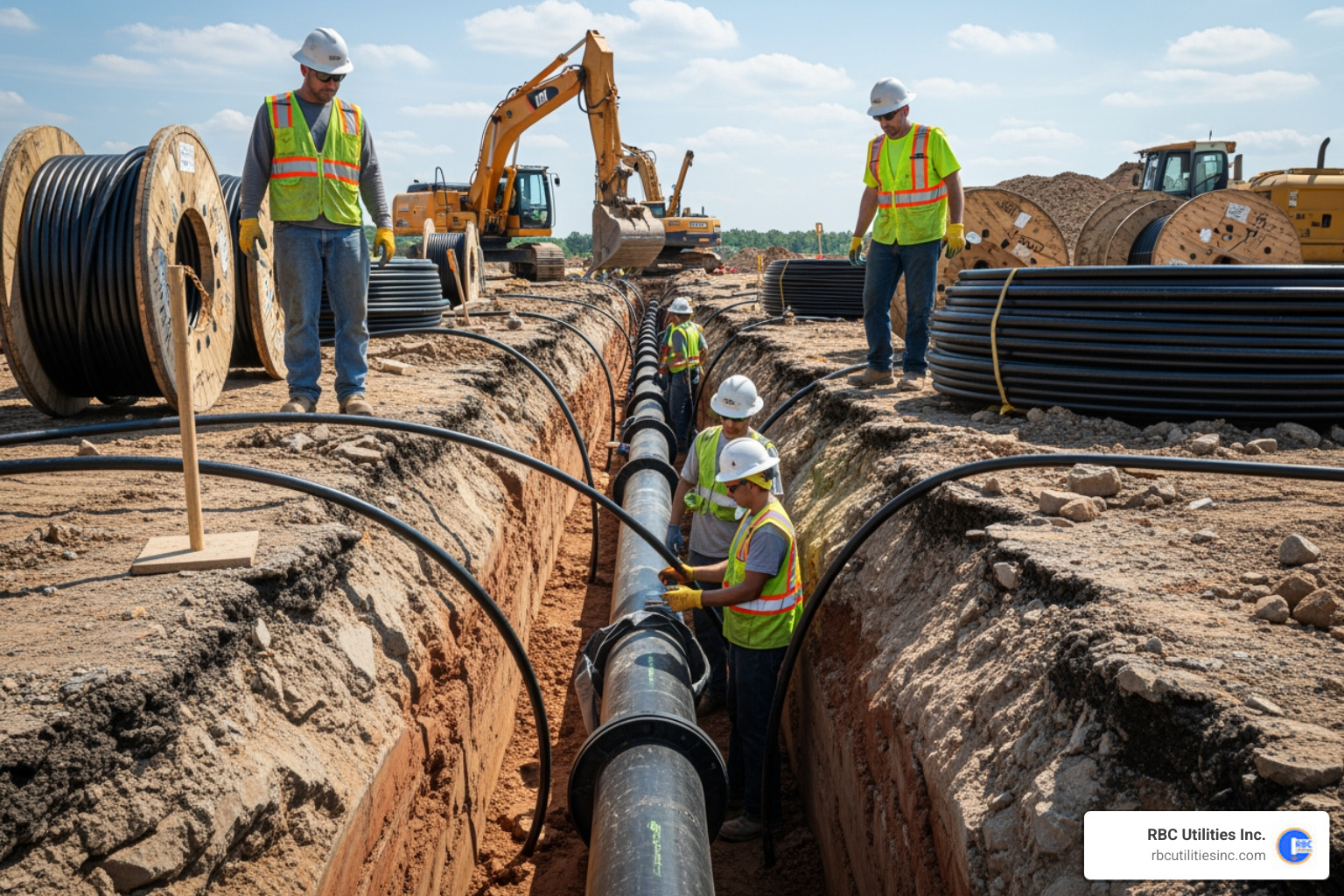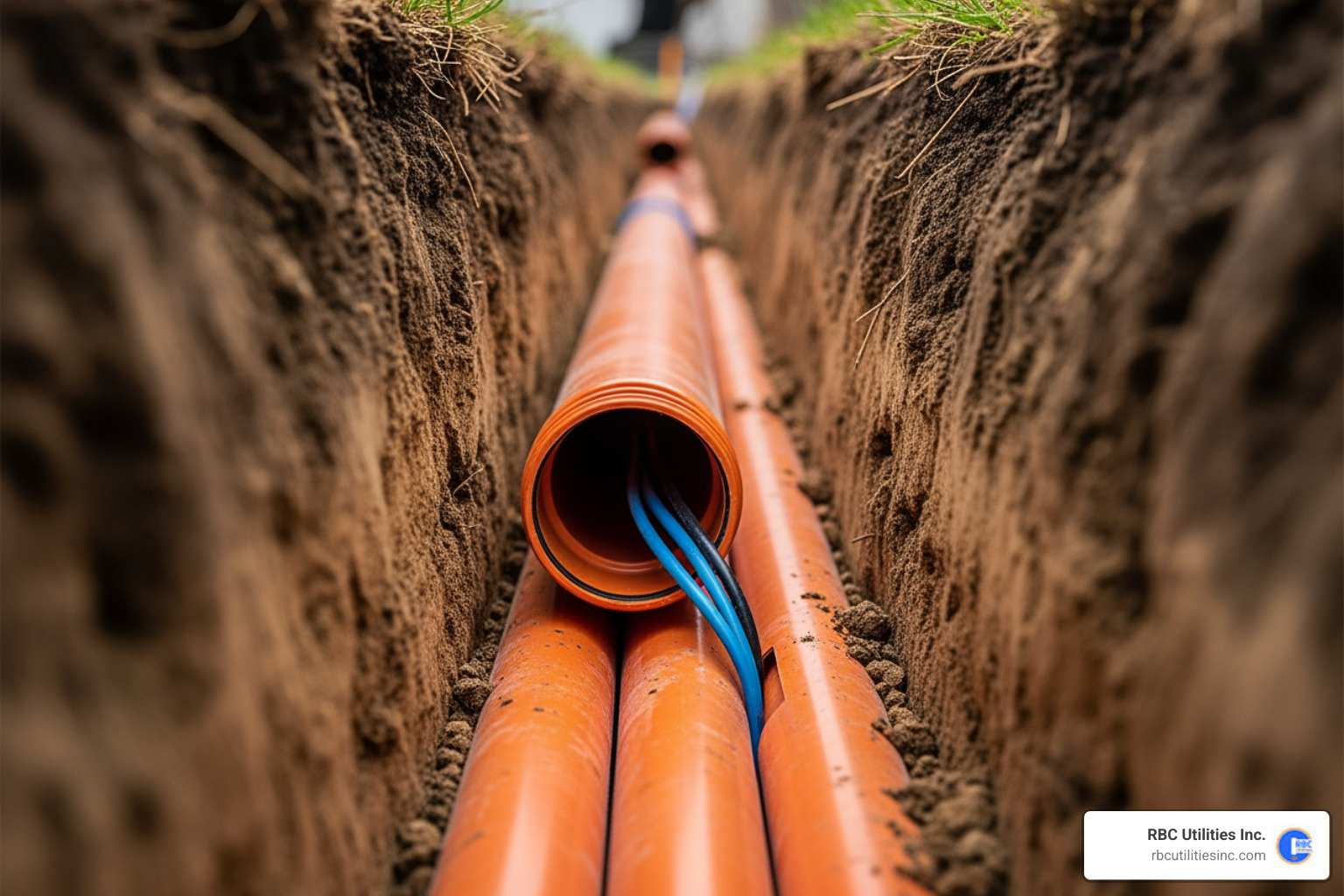
Conduit for underground power is the protective tubing that houses electrical wiring beneath the ground, shielding it from moisture, physical damage, and corrosion.
Quick answer — the most common conduit types used for underground power:
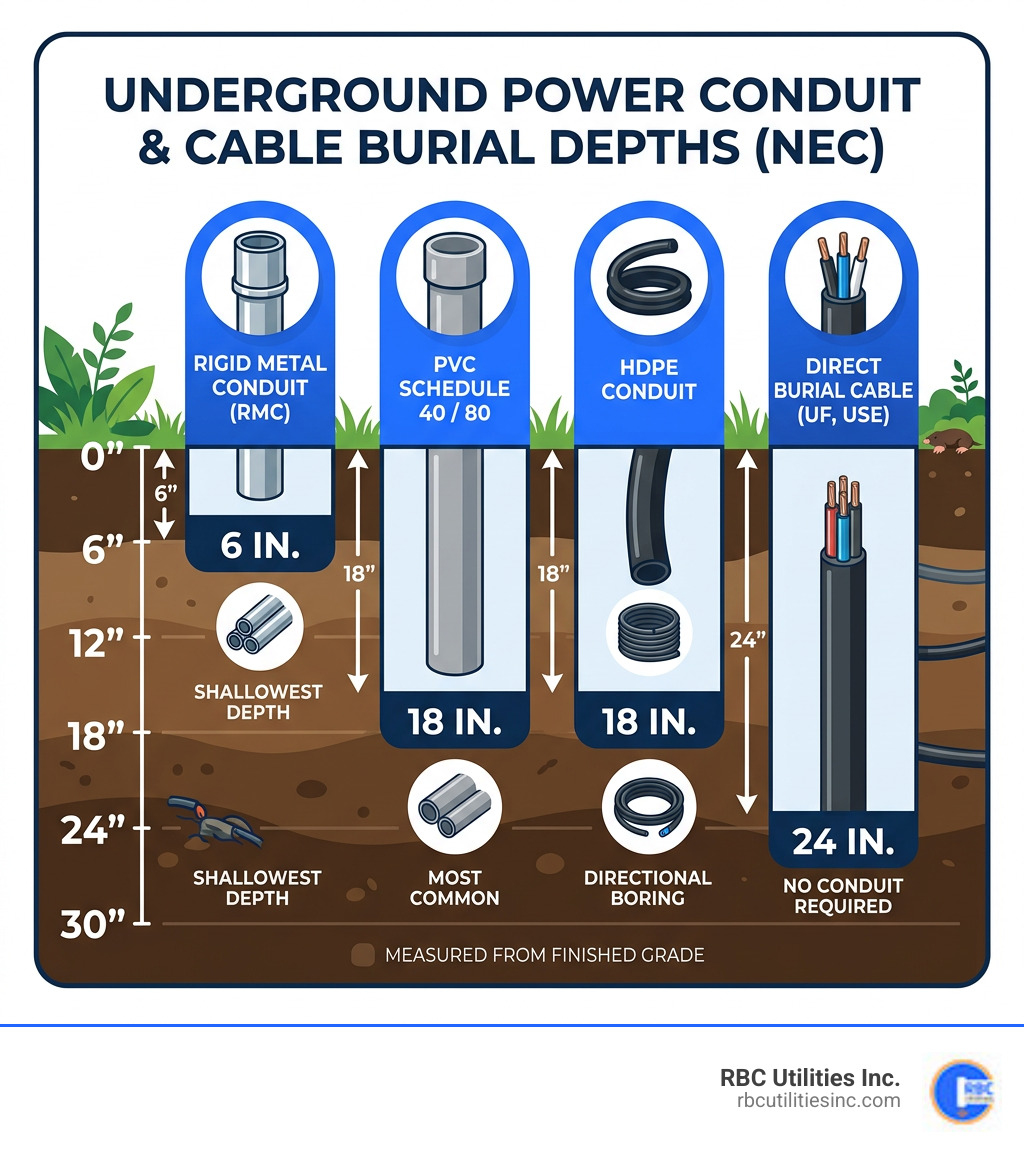
| Conduit Type | Min. Burial Depth | Best For |
|---|---|---|
| PVC Schedule 40/80 | 18 inches | Residential & commercial runs |
| Rigid Metal Conduit (RMC) | 6 inches | Areas needing shallower burial |
| HDPE | 18–24 inches | Directional boring, long runs |
| Fiberglass (RTRC) | 18 inches | Harsh environments, industrial |
| Direct burial cable (no conduit) | 24 inches | Simple, low-cost residential |
Every underground electrical installation — whether it's a new home, a commercial build, or an industrial site — depends on the right conduit to keep power flowing safely for decades.
Get it wrong and you risk failed inspections, costly dig-ups, and real safety hazards. Get it right and you've got a system that's reliable, code-compliant, and built to last.
For developers and contractors in the Carolinas, underground conduit decisions affect project timelines, budgets, and long-term liability. The National Electrical Code (NEC), local utility standards, and safety regulations like the 811 "Call Before You Dig" requirement all shape what you can and can't do underground.
This guide breaks down everything you need to know — materials, sizing, burial depths, installation methods, and compliance standards — so you can make confident decisions on your next project.
Selecting the right material for your conduit for underground power is the first step in ensuring a long-lasting infrastructure. In the Carolinas, our soil can range from heavy clay to sandy coastal earth, and each material reacts differently to these conditions.
| Material | Durability | Corrosion Resistance | Best Application |
|---|---|---|---|
| PVC (Sch 40/80) | High | Excellent | Standard trenches, risers |
| HDPE | Very High | Excellent | Directional boring, long runs |
| Fiberglass (RTRC) | Superior | Excellent | High-heat, industrial, bridges |
| Rigid Metal (RMC) | Highest | Moderate (needs coating) | Shallow burial, high-impact |
For most residential and commercial projects we handle, PVC is the go-to choice. It’s lightweight, cost-effective, and completely immune to the rust that can plague metal pipes in damp soil. However, for specialized needs like crossing under a busy Charlotte roadway without digging up the asphalt, we often turn to HDPE. Learn more about underground conduit types to see how these materials differ in technical composition.
You can't just pick a pipe size that "looks right." Conduit sizing is strictly regulated by the NEC and local utility companies like Duke Energy or various cooperatives across North and South Carolina. The size depends on the service amperage and whether the power is single-phase (common for homes) or three-phase (standard for commercial/industrial).
Always remember: it is much cheaper to install a slightly larger conduit now than to realize your wires won't fit during the pull. We recommend checking with your local utility provider, as some have specific "oversizing" rules for runs exceeding 200 feet.
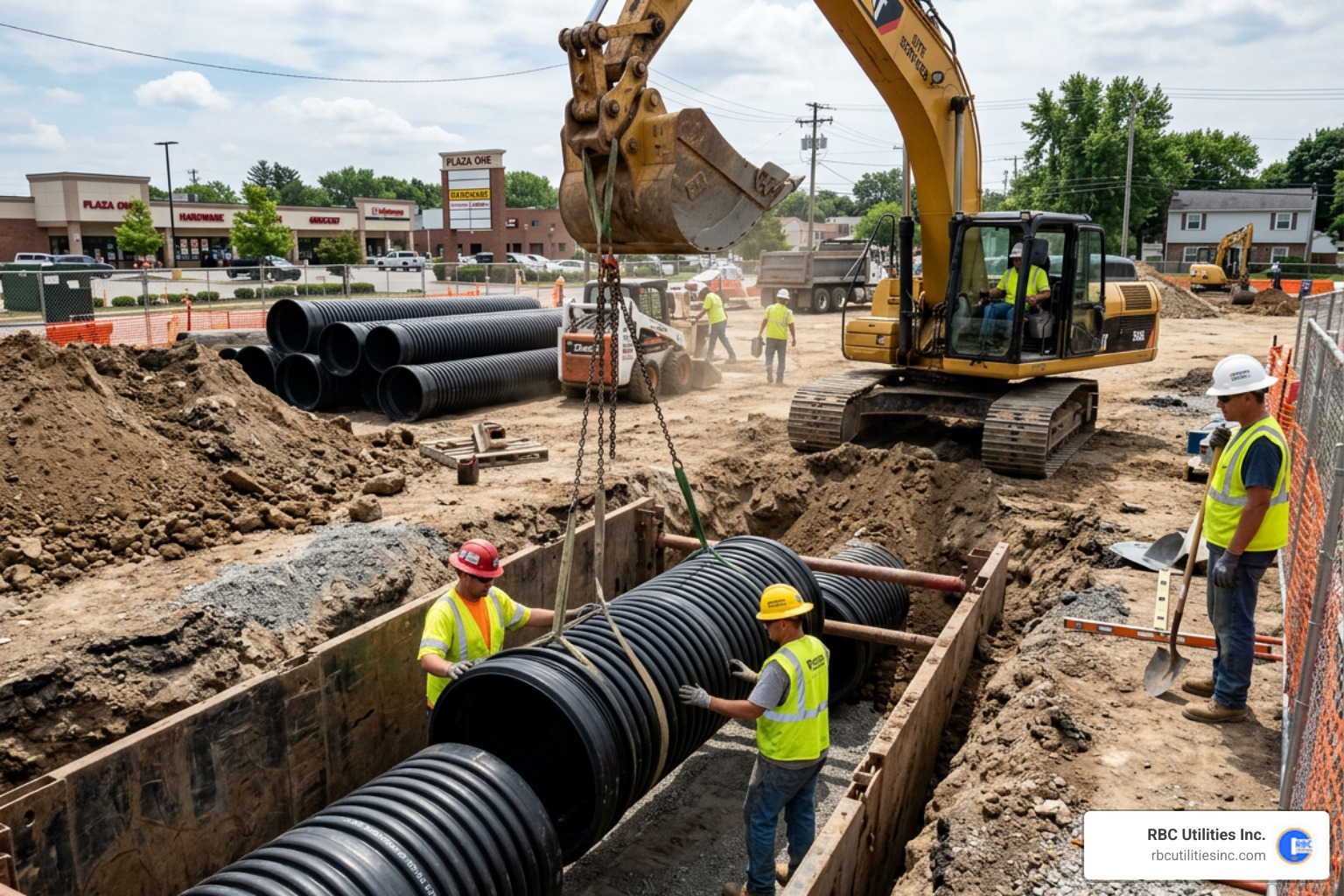
While PVC is popular, Fiberglass (Reinforced Thermosetting Resin Conduit or RTRC) and HDPE (High-Density Polyethylene) are the heavy hitters of the underground world.
Fiberglass conduit is incredibly stable. It doesn't melt or fuse to the wire insulation if there’s a short circuit (a phenomenon known as "burn-through"), and it maintains its shape across a massive temperature range. It’s also much lighter than metal, which saves our crews' backs during installation.
HDPE is the king of flexibility. Because it comes on huge reels, we can install thousands of feet without a single joint. This makes it the perfect candidate for horizontal directional drilling (HDD). Its high crush resistance and low coefficient of friction mean that when it's time to pull those heavy copper or aluminum cables, they slide through with minimal resistance.
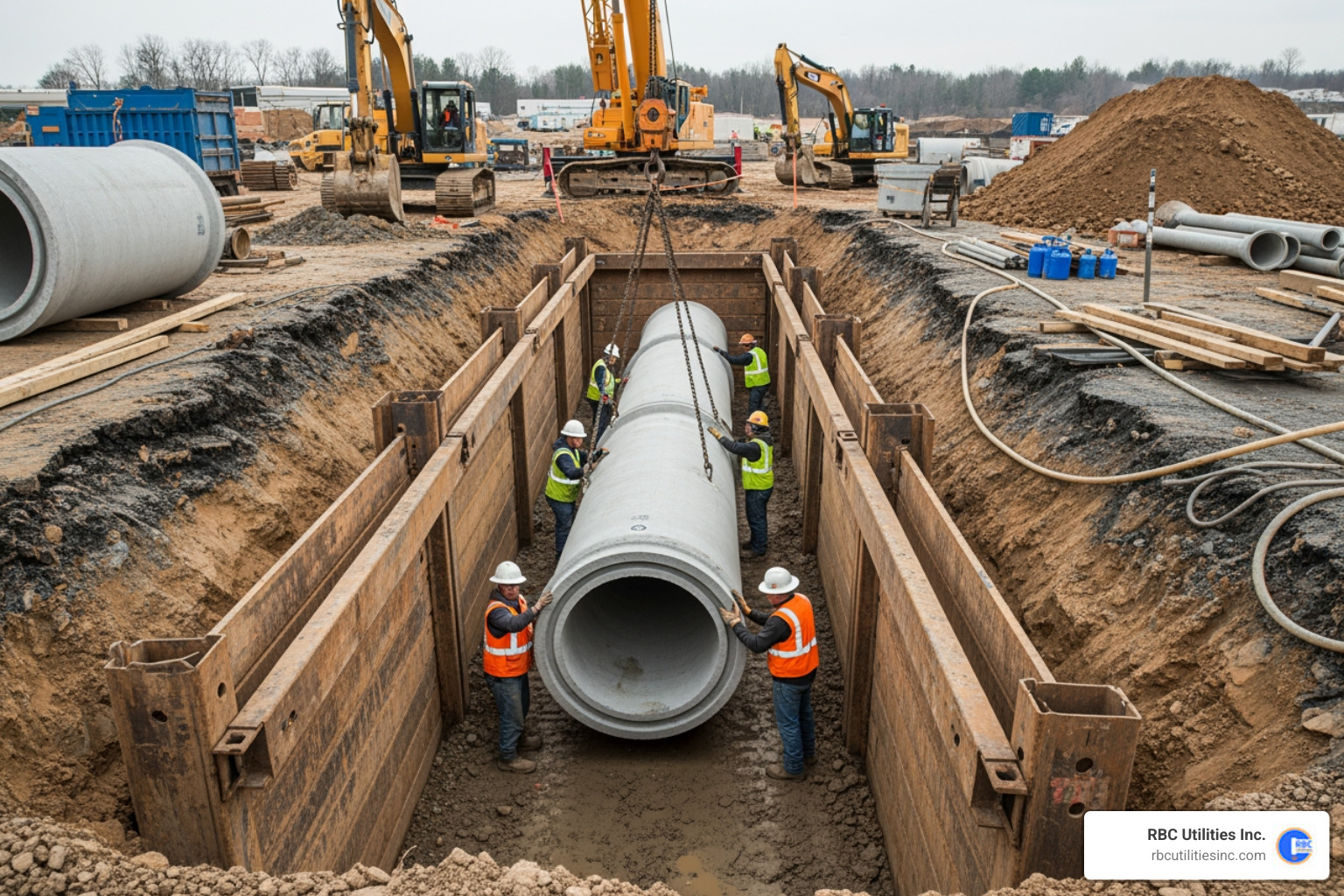
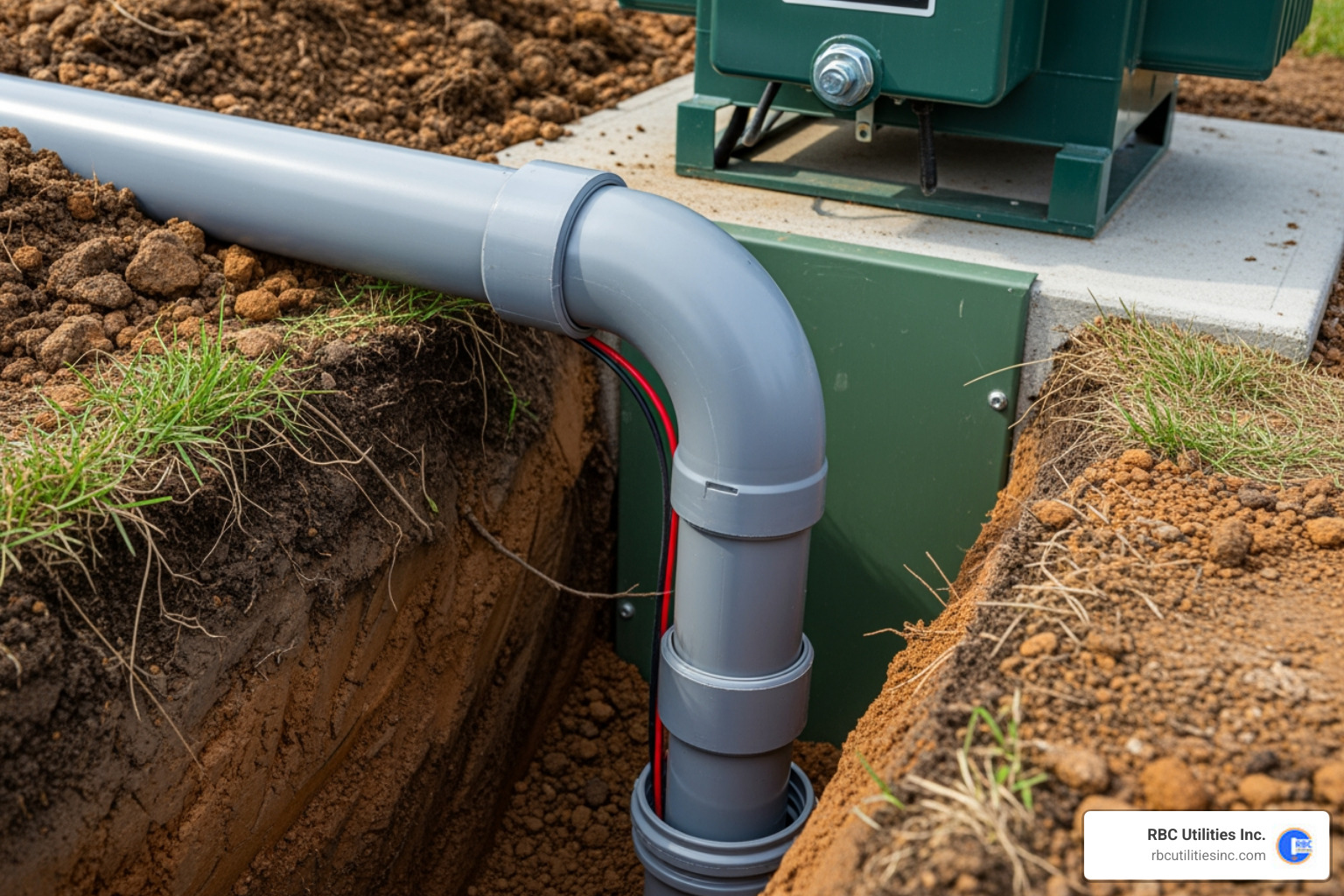
Installing conduit for underground power isn't just about digging a hole and dropping in a pipe. It is a precise engineering task. One of the most critical components is the "sweep"—the long-radius elbow that allows the conduit to transition from the horizontal trench to a vertical position, such as entering a transformer pad or a meter base.
To ensure a system that passes inspection the first time, we follow a strict set of best practices:
NEC Table 300.5 is the "bible" for burial depths. In the Carolinas, these are the standard minimums for "cover" (the distance from the top of the conduit to the finished grade):
If the conduit is running under a driveway or a parking lot where heavy vehicles will pass, the requirement usually increases to 24 inches regardless of the conduit type. For commercial projects in North Carolina, we often aim for a 36-inch trench depth to ensure we maintain at least 30 inches of cover after the site is leveled and landscaped. More info about our conduit construction services can help you understand how we manage these requirements on large-scale sites.
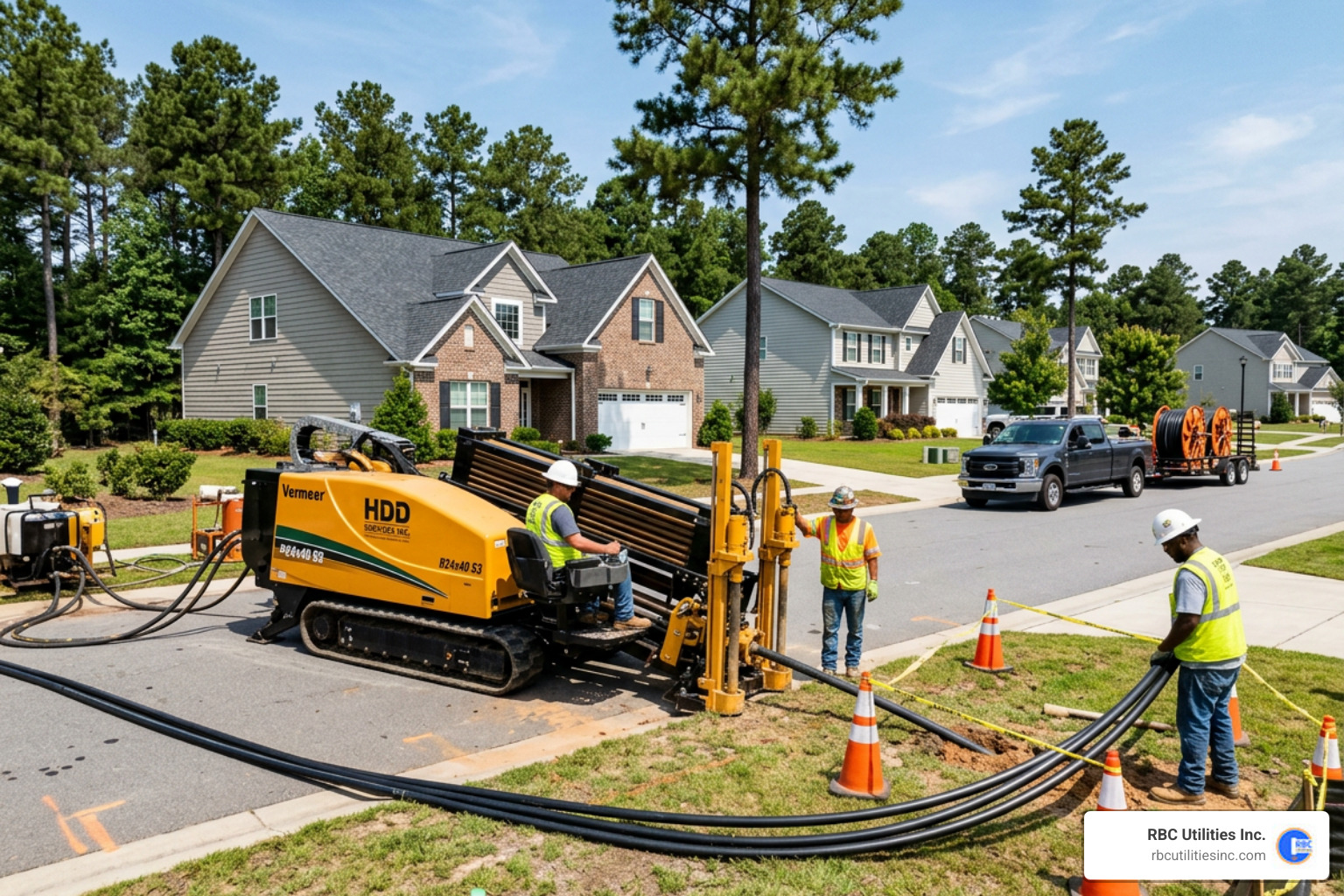
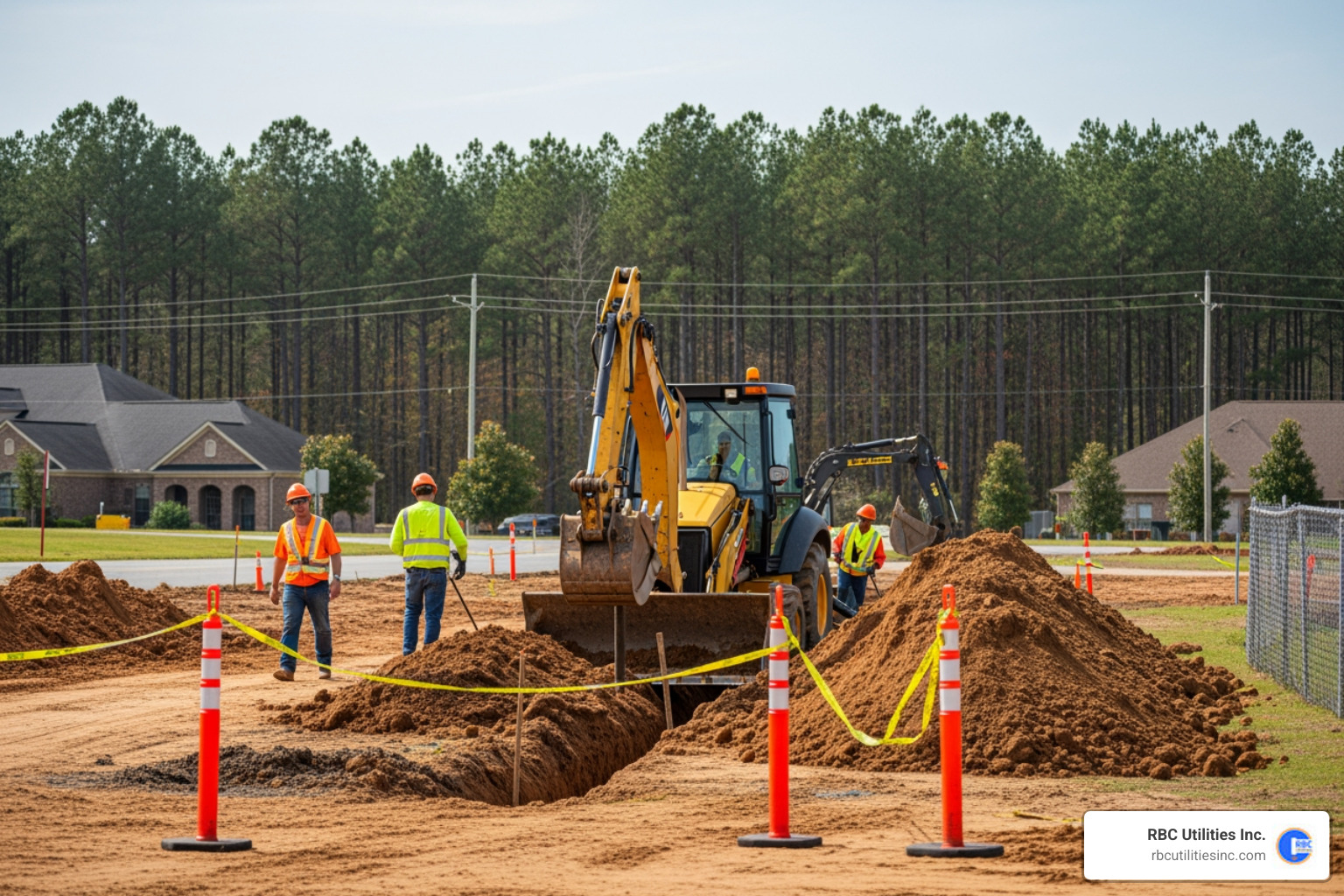
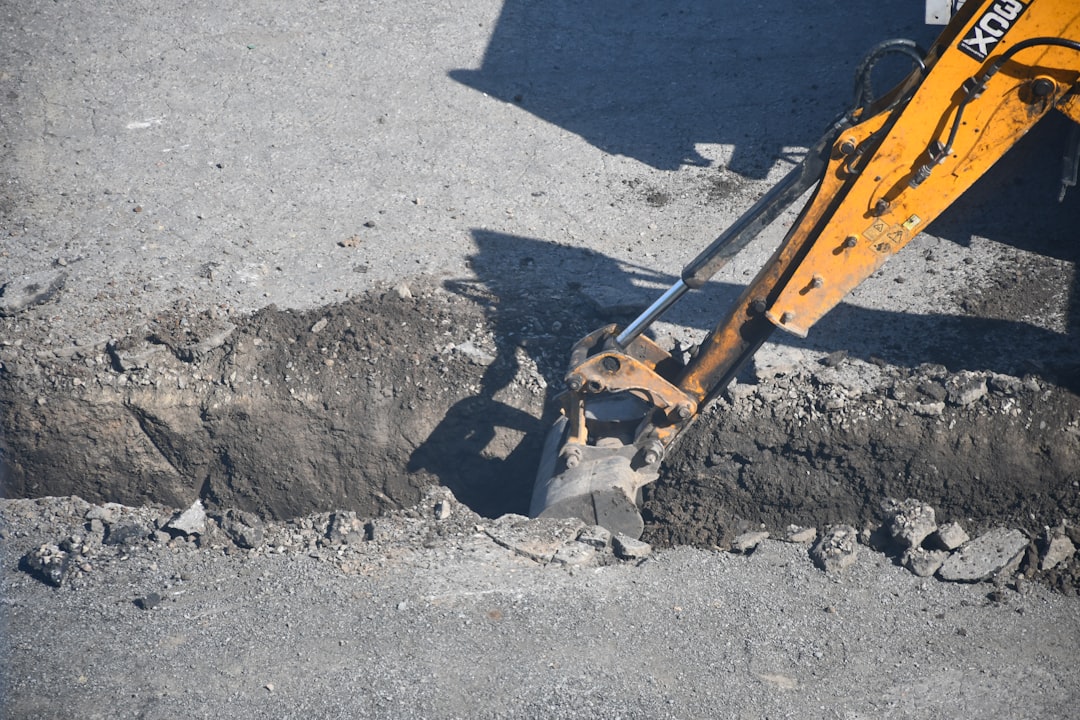
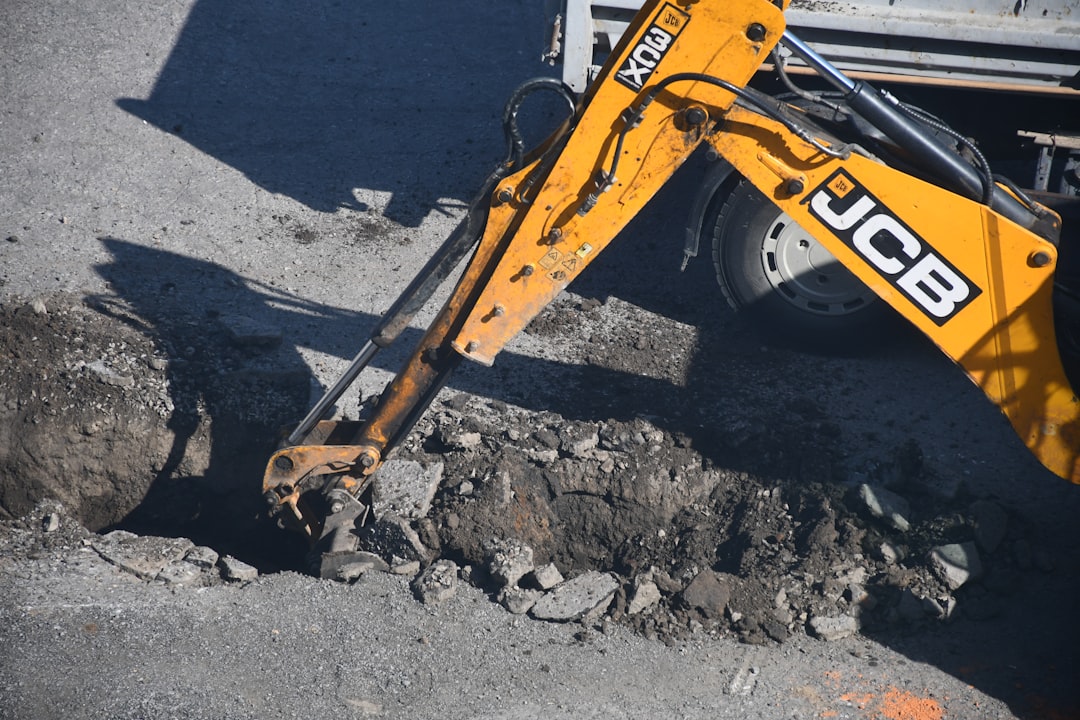
In the old days, if you wanted to run power, you had to dig a trench. Today, we have options. Traditional trenching is often the most cost-effective for open fields or new residential developments. However, if we need to cross a manicured lawn, a paved road, or an environmentally sensitive creek in South Carolina, we use Horizontal Directional Drilling (HDD).
HDD is "trenchless." We drill a pilot hole, enlarge it with a reamer, and pull the HDPE conduit through. There is minimal surface disruption, which often saves the client thousands of dollars in site restoration costs (like repaving or re-sodding).
Sometimes, the "earth cover" isn't enough protection. In high-traffic industrial areas or for high-voltage primary lines, we build "duct banks." This involves laying multiple conduits, held in place by plastic spacers, and then encasing the entire bundle in concrete.
We maintain at least 2 inches of concrete coverage on all sides. This creates a "red-mix" barrier (often dyed red to warn future excavators) that is virtually impossible to dig through accidentally. We typically place spacers every 5 to 8 feet to ensure the conduits don't shift or float when the concrete is poured.
The longer the run, the harder the pull. Friction builds up quickly, especially around bends. The general rule of thumb is to limit runs to 200 feet between pull points.
Additionally, you must follow the 270-degree rule: no more than the equivalent of three 90-degree elbows in a single run. If your path requires more turns, you must install a pull box or a vault. These enclosures provide a resting point where crews can safely pull the wire out and re-feed it into the next section of the run. Watch professional wire pulling tools in action to see how specialized equipment helps manage these high-tension pulls.
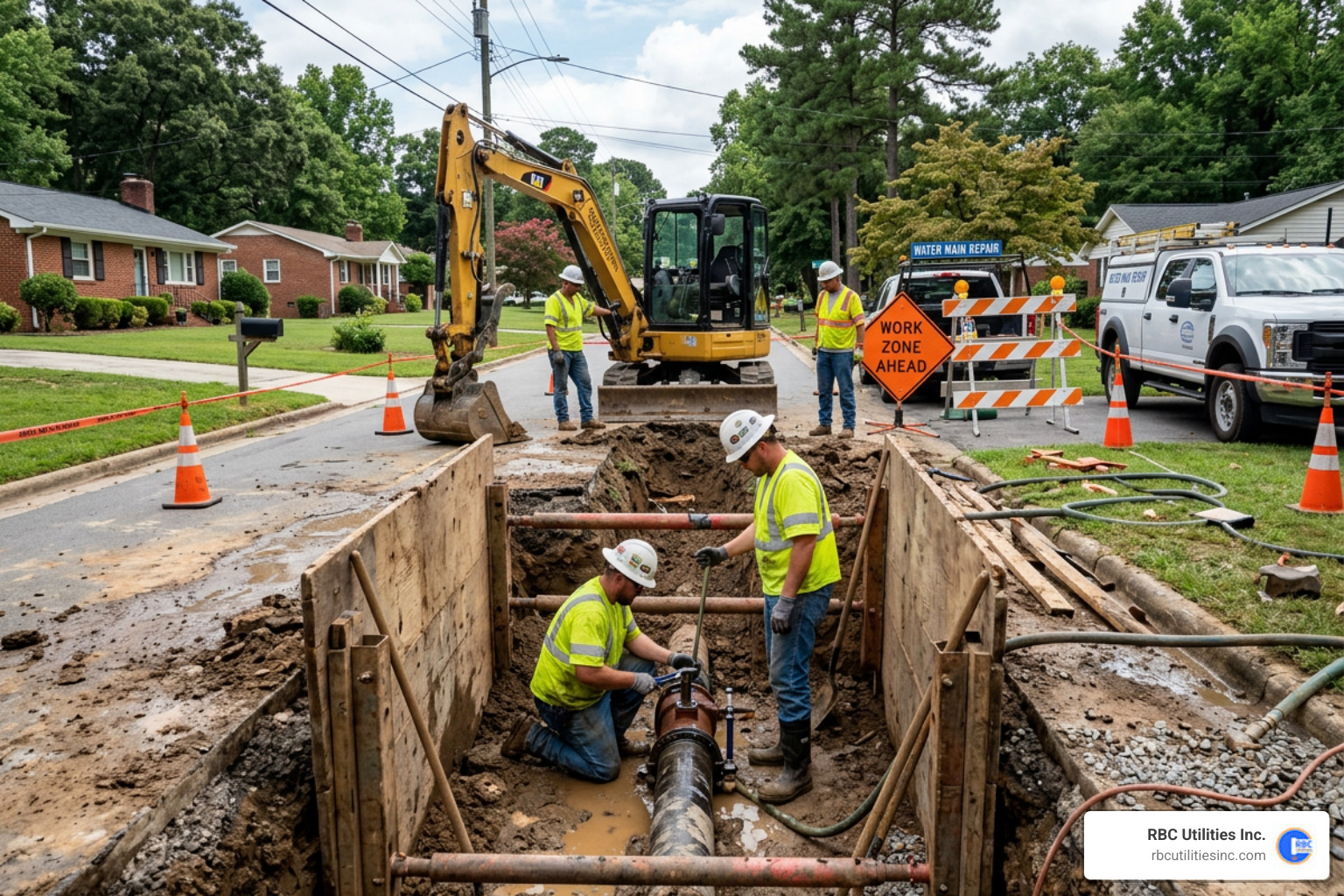
Safety is our absolute priority at RBC Utilities Inc. Before a single shovel hits the dirt in Charlotte or anywhere else in the Carolinas, we coordinate with 811.
You can't just throw all your pipes in one hole without a plan. To prevent cross-contamination or accidental damage during repairs, the NEC and local codes require specific separation:
Joint trench construction is a great way to save money, but it requires expert coordination to ensure every utility stays in its designated "lane."
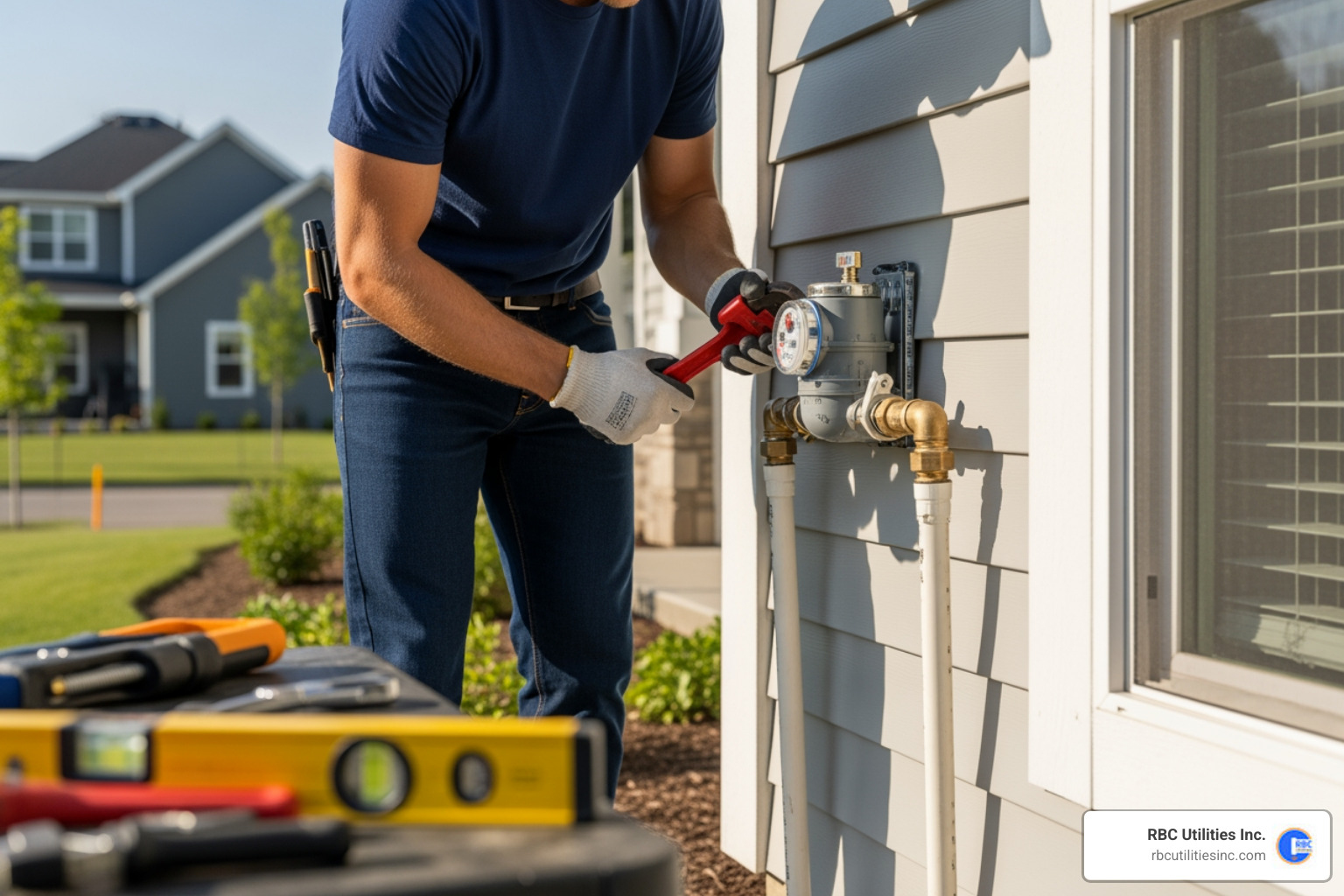
Where the conduit for underground power leaves the earth, it enters a vulnerable stage. This transition point is usually handled by a Schedule 80 PVC riser. We use Schedule 80 because it is thicker and rated for "physical damage," which is likely to happen near the ground level from lawnmowers or vehicles.
We also install expansion joints on these risers. Soil settles and shifts over time; without an expansion joint, the settling earth can actually pull the meter base right off the side of a house or snap the conduit.
For most residential and commercial applications not subject to heavy vehicle traffic, the NEC requires a minimum of 18 inches of cover for PVC conduit.
The code allows for a total of 360 degrees of bends, but utility companies often limit this to 270 degrees (three 90-degree bends) to ensure the wire can be pulled without damaging the insulation.
Generally, no. Most local codes in the Carolinas require Schedule 80 PVC for any portion of the conduit that is exposed above ground level, as it provides much better protection against impact.
Building a reliable conduit for underground power system requires a mix of technical knowledge, the right equipment, and a deep understanding of local Carolinas regulations. Whether you are developing a new subdivision in Charlotte or upgrading industrial power in South Carolina, the infrastructure you put in the ground today will dictate the safety and reliability of that site for the next fifty years.
At RBC Utilities Inc., we take pride in doing the job right the first time. Backed by the national resources of Saga Infrastructure, our local teams bring decades of expertise to every trench and bore we manage. We don't just lay pipe; we build the backbone of our communities.
Ready to start your next underground project? Trust the experts who know the Carolinas' dirt better than anyone.
Part of Saga Infrastructure, protecting what others built and helping it grow.
Address: 4404 Stuart Andrews Blvd., Suite K, Charlotte, NC 28217
Email: info@rbcutilitiesinc.com
Phone: 803-913-9727
Service Area: North Carolina | South Carolina